The short answer
- A job should move in one direction: receiving to packing, never doubling back
- Press and dryer must be adjacent — that walk happens on every garment
- Screen washout must be separate from anything that must stay dry or clean
- Store blanks near receiving, finished goods near dispatch, screens near the press
- Walk a real job with a tape measure before moving anything heavy
Layout is the cheapest productivity improvement available to a decorating shop and the least often revisited. Most shops arrange themselves once, when the equipment arrives, and then grow by putting new machines wherever there is space — which produces a floor where a job crosses the room four times.
Nobody notices, because each individual walk is short. Across a year they are a substantial fraction of somebody's job.
A job should move in one direction
The principle is simple: material enters at one end and leaves at the other, and never travels backwards. Every backtrack is a walk that repeats on every job for as long as the layout stays that way.
The sequence for screen printing is fixed by the process:
| Step | Zone |
|---|---|
| 1 | Receiving and goods in |
| 2 | Blank storage |
| 3 | Art and film output |
| 4 | Screen room — coat, expose, washout, dry |
| 5 | Press |
| 6 | Dryer |
| 7 | Inspect, fold, pack, dispatch |
Where a shop cannot lay that out as a straight line — and most cannot — a U shape works, with receiving and dispatch adjacent at the open end. That is often better than a line, because the same person can handle goods in and goods out.
The seven zones
Each needs a defined space rather than a spot it drifted into. The commonest layout fault is a zone with no boundary, which becomes a place where things accumulate.
Give each of these a defined area
- Receiving — space to open, count and check a delivery against the purchase order
- Blank storage — racked by style and size, not stacked by order
- Art and film — dust-free, near the screen room
- Screen room — coating, exposure, washout, drying, racking
- Press — with clear space to load and unload
- Dryer — with catch space at the exit
- Pack and dispatch — bench height, boxes, labels, scales
The catch space at the dryer exit is the one shops forget. Garments emerging with nowhere to go get stacked on the floor or on top of each other while still warm, which is how prints get marked after they were printed correctly.
What must be adjacent
Three pairings, and they are worth prioritising over everything else in the plan.
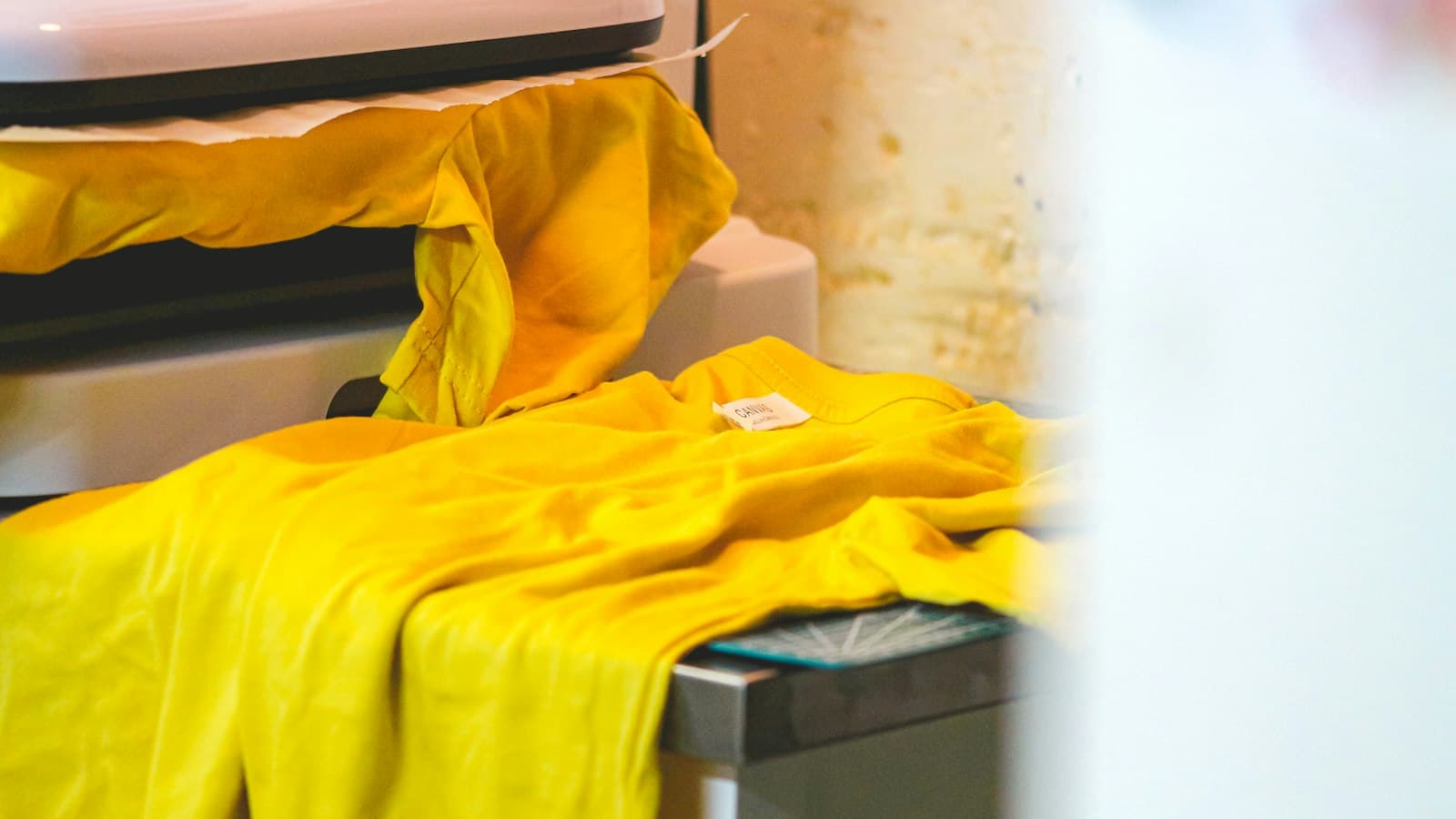
Press and dryer. Every single garment makes this journey, so it is the most repeated movement in the shop. It should be a step, not a walk. If nothing else in your layout is optimal, get this one right.
Screen racking and press. Screens are fetched at every setup and returned at every changeover. On a shop doing many short runs, that is dozens of trips a day.
Receiving and blank storage. Boxes are heavy and awkward, and carrying them across a shop is both slow and a genuine injury risk.
Optimise the walk that happens on every garment before the one that happens once a job.
What must be separate
Washout from everything. The screen washout area produces water and emulsion residue, and both are hostile to art output, finished goods and any digital printer. Give it its own corner with drainage and containment.
Digital printers from lint and dust. Folding, packing and dryer lint are all sources of airborne fibre, and a DTG printhead does not thrive on it. Keep digital equipment away from those, and remember it also has a specified temperature and humidity range.
Finished goods from raw blanks. A physical separation prevents the single most avoidable error in the shop, which is decorating a garment that was already decorated or packing an undecorated one.
Heat from anything cooled. A dryer changes the ambient temperature around it, and putting a digital printer or an ink store next to one creates problems that are hard to diagnose later.
Storage that does not become archaeology
Storage is where layouts decay. The rule that keeps it usable is to store by what it is, not by which job it belongs to.
Blanks racked by style and size can be found by anyone and counted at a glance. Blanks stacked by order become an archaeology problem the moment an order is cancelled or partially used, and shops accumulate years of orphaned stock that way.
Storage rules that hold up
- Blanks by style then size, with the label facing out
- Screens racked by mesh count, clearly marked — the wrong mesh is a real cost
- Ink by colour with the mix records kept alongside
- Finished goods by job number, in one place, checked before dispatch
- A quarantine shelf for anything queried, so it cannot ship by accident
- Consumables where they are used, not in a central cupboard
The quarantine shelf earns its space quickly. Anything with a question against it — a possible misprint, a short count, a garment being checked — needs somewhere it physically cannot be picked from, or eventually it will be.
Testing a layout before you move anything
Walk a real job, with a tape measure and a notepad, before shifting anything heavy.
The walkthrough
- Take one recent job and physically walk every step in order
- Note each time you double back — those are the problems
- Measure the press-to-dryer distance; multiply by the pieces in the job
- Count how many times you cross another zone to reach something
- Do it again for an embroidery job and a digital job — they differ
- Sketch the fix on paper and walk it again before moving machinery
The multiplication is what makes it concrete. A press-to-dryer walk of four metres on a 240-piece job is nearly a kilometre of walking on one order, and that is repeated on every job you run.
Layout also shapes what your scheduling can promise. A shop where jobs queue in a defined place, in a known order, can be planned; one where work accumulates wherever there is space cannot, whatever the software says. Getting the floor right is what makes production scheduling reflect reality rather than intention. The rest of the equipment archive assumes a job moves in one direction.