The short answer
- US commercial embroidery runs $0.50–$1.50 per 1,000 stitches, with $1–$3 quoted as a broader baseline
- Per stitch that is $0.005–$0.015, with $0.01 a common working figure
- A 5,000–8,000 stitch chest logo lands at $3–$10 a garment; a cap front $4–$8
- Stitch count ignores colour changes, small lettering and awkward hooping — price those separately
- Digitising is a one-off $40–$100, not part of the run rate
Embroidery pricing looks like the most objective thing in decorated apparel. The file states a stitch count, you multiply by a rate, and there is your price. That arithmetic is genuinely useful and it is also the reason a lot of shops lose money on embroidery without ever seeing where.
Stitch count measures how much thread goes into a garment. It does not measure how much of your time the job takes, and those two things diverge more than you would expect.
What are the published rates?
Commercial embroidery in the US sits at $0.50 to $1.50 per 1,000 stitches in 2026, with $1 to $3 per 1,000 quoted as a wider general baseline. Expressed per stitch, most shops charge $0.005 to $0.015, and a cent per stitch is the figure that comes up most often as a working default.
| Basis | Typical 2026 range |
|---|---|
| Per 1,000 stitches, commercial | $0.50 – $1.50 |
| Per 1,000 stitches, general baseline | $1 – $3 |
| Per stitch | $0.005 – $0.015 |
| Common working figure | $0.01 per stitch |
That spread is wide because it is doing several jobs at once. Volume orders sit at the bottom of the range; small runs and rush work sit at the top. A rate quoted without a quantity attached is not really a rate.
What does a garment actually come to?
Working from finished prices rather than from the rate is the faster sanity check, and the published figures are consistent.
| Placement | Stitches | Typical price per garment |
|---|---|---|
| Small chest logo | 5,000 – 8,000 | $3 – $10 |
| Cap front | varies | $4 – $8 |
| Full back | 15,000 – 25,000 | $10 – $30 |
Check your own list against those bands. A shop charging $2 for a 7,000-stitch chest logo is below the market and almost certainly below cost once machine time is counted. A shop charging $18 for the same logo needs a reason — a difficult garment, a tiny run, a genuine rush — and should be able to say what it is.
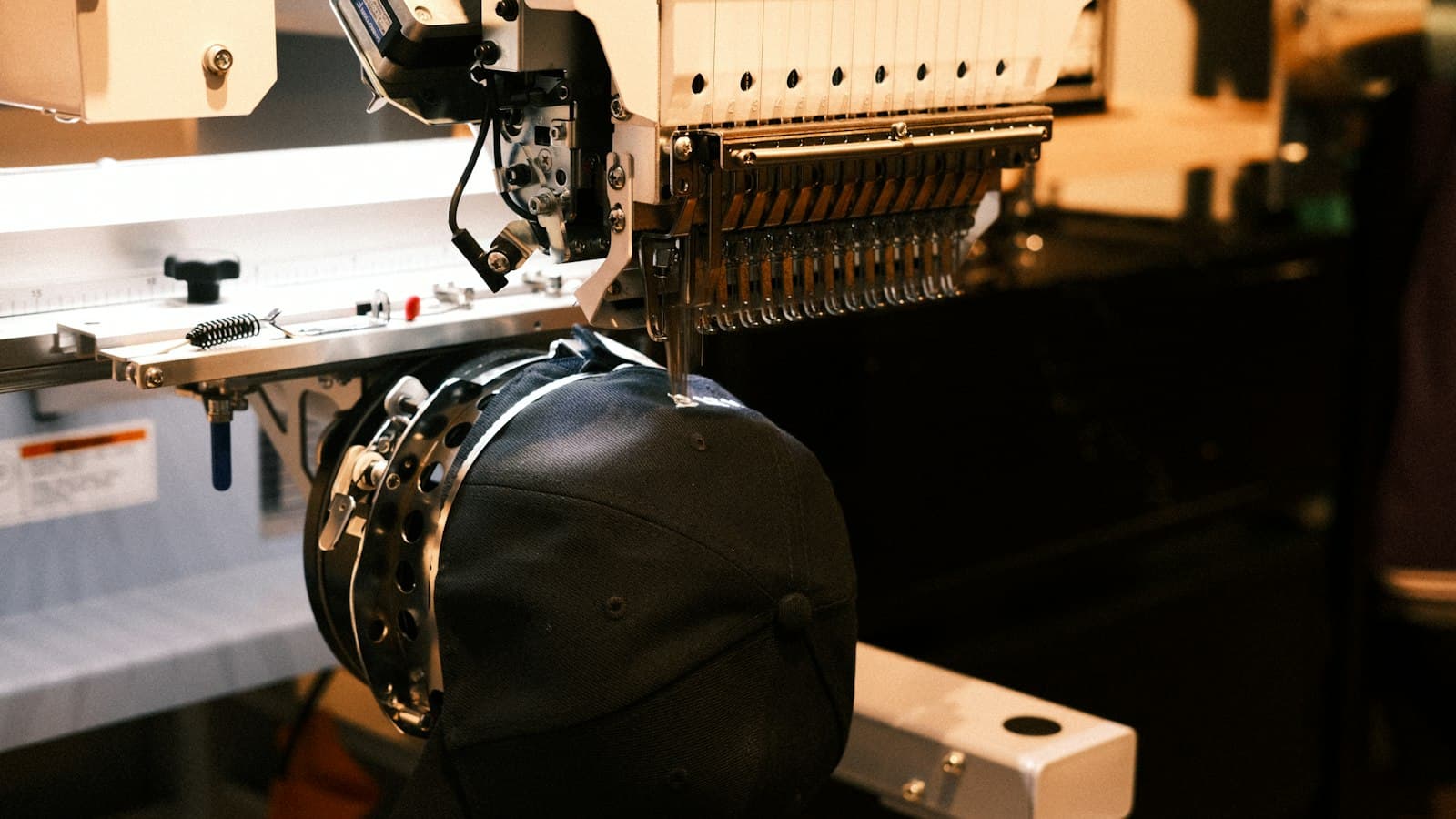
The cap row is worth noticing because it has no stitch count against it. Caps are priced by placement rather than by stitches in most shops, and for good reason: hooping a cap, running a curved surface and dealing with the seam is skilled handling that a stitch count does not describe.
Stitch count tells you how much thread. It tells you nothing about how much attention.
Where does stitch count mislead you?
Two designs with identical stitch counts can take very different amounts of labour. That is the whole problem, and it is the reason a pure per-stitch price list quietly subsidises your hardest work.
Colour changes. Every change is a trim, a thread change and a restart. A 9,000-stitch design in three colours runs cleanly; the same count in nine colours stops constantly, and machine time is not proportional to stitches when the machine spends its day trimming.
Small lettering. Fine text is the most failure-prone thing in embroidery. It needs a higher stitch density, it is unforgiving of any movement in the fabric, and it is where thread breaks cluster. Low stitch count, high attention.
Awkward hooping. A flat left chest on a polo hoops in seconds. A pocket, a placket edge, a sleeve, a bag, a finished jacket lining — all take real time per piece, and that time repeats on every single garment rather than once per job.
Difficult fabrics. Performance knits move, fleece needs different underlay, waterproof shells cannot be hooped conventionally. All add handling and all raise the reprint risk.
Add to the stitch price when the job has
- More than about four colour changes
- Lettering under roughly 5mm
- Placement that is not a flat chest or a standard cap front
- Stretch, pile or coated fabric
- Individual names — this is a per-garment setup, not a per-job one
- A quantity below your minimum efficient run
The names line deserves emphasis because it is where team and staff orders lose money. Individually named garments mean a file change and a re-hoop for every single piece, so twenty-four named shirts is twenty-four setups. That belongs in the price as a per-name charge, and it should be stated on the quote rather than absorbed.
Why the minimum matters more than the rate
Most embroidery is small. A left chest logo is frequently under 8,000 stitches, so at a cent per stitch the arithmetic gives $80 for a ten-piece order — and the machine time, hooping, threading and handling for ten garments is not covered by that on any honest accounting.
This is why every established embroidery shop has a minimum, and why comparing rates without comparing minimums is meaningless. A shop at $0.60 per thousand with a high minimum can be dearer on your actual work than one at $1.20 with none.
Set yours from your own numbers: how long does it take to load a design, thread the machine, hoop a garment, run it and unhoop it? Multiply by your labour rate, add machine time, and that is the floor beneath which an order costs you money regardless of stitch count. The same logic governs setup on screen printing — fixed work that does not shrink with quantity.
Digitising is a separate, one-off charge
Turning a logo into a stitch file is skilled work priced independently of the run. Shops commonly charge a one-off $40 to $100 for it, and it is reused on every future order with that logo.
Present it that way explicitly, because the framing changes how it lands. A customer told "digitising is $65, and you will never pay it again for this logo" hears an investment. The same customer told "there's a $65 setup fee" hears a surcharge, and pushes back.
It also gives you a genuinely persuasive reorder argument. The second order is cheaper than the first by a real, nameable amount, which makes reordering the obvious choice. What the digitising itself should cost you to buy in — and when it is worth bringing in-house — is covered in what embroidery digitising should cost.
Building your own price list
Work upward from machine time rather than downward from a market rate. Your machine has a cost per hour — finance or depreciation, floor space, power, thread and backing, and the operator. Your machine also has a real stitch rate, which is not the headline figure on the spec sheet once trims and colour changes are included.
The build
- Work out your true cost per machine hour, operator included
- Measure your real stitches per hour on a typical multi-colour job, not a demo
- Divide to get cost per thousand stitches, then add margin
- Add handling per garment — hooping and unhooping, by placement
- Set a minimum order that covers threading and setup
- Price names, caps and difficult placements as separate lines
- Sanity-check the result against the $3–$10 chest logo band
That last step is the one to keep. Building from your own costs can produce a number well outside the market in either direction, and both are informative — too high usually means your real stitch rate is worse than you assumed, too low usually means you have forgotten the operator.
Then structure the list with quantity breaks that hold up, and put the digitising, the minimum and the per-name charge on the quote as visible lines. An itemised embroidery quote survives scrutiny in a way a single per-garment figure does not, and it is what makes a price defensible when somebody asks — which is the whole point of quoting from decisions you made in advance. The rest of the pricing archive assumes your list is built rather than borrowed.