The short answer
- Headwear blanks cost more than shirts and carry tighter supplier minimums
- Cap embroidery runs slower than flat embroidery on the same stitch count
- A structured front needs backing, sometimes a different needle, and more operator attention
- Quantity breaks flatten sooner because the blank dominates the price
- Quote headwear on its own line — never fold it into a shirt price
Caps look like an easy add-on to an apparel order and price like a separate product. Shops that quote them from a shirt template usually lose money on the first order and only notice when they work out what the run actually earned.
Why caps are different
Three structural facts drive everything else. The blank is a larger share of the sell price, the decoration is slower per unit, and the quantities are almost always smaller than the shirt order they arrive attached to.
On a shirt, decoration frequently costs more than the garment, so volume in the decoration is what moves the price. On a cap the blank often costs more than the stitching, which means discounting on quantity has far less room to work.
On shirts you are selling decoration. On caps you are largely reselling a blank, and reselling has thinner margins.
The blank
| Style | Notes for pricing |
|---|---|
| Unstructured / dad cap | Cheapest; easiest to hoop and run |
| Structured six-panel | Buckram front; needs care, runs slower |
| Trucker / mesh back | Mesh can distort; front panel only |
| Flat-brim snapback | Popular, dearer blank, higher expectations |
| Performance / fitted | Sized stock — you must carry a range |
| Beanies | Stretch fabric; hooping is the whole problem |
Fitted styles carry a cost the price list does not show. Where a shirt order needs one blank in six sizes, a fitted cap order needs stock in each size, and the sizes that do not sell sit on a shelf — so the leftover stock is part of the cost of the job.
Headwear also tends to carry stricter case quantities and colour minimums from suppliers. Check before quoting rather than after, because discovering a two-dozen minimum on a twelve-cap order after you have given a price is entirely avoidable.
Embroidery on a cap
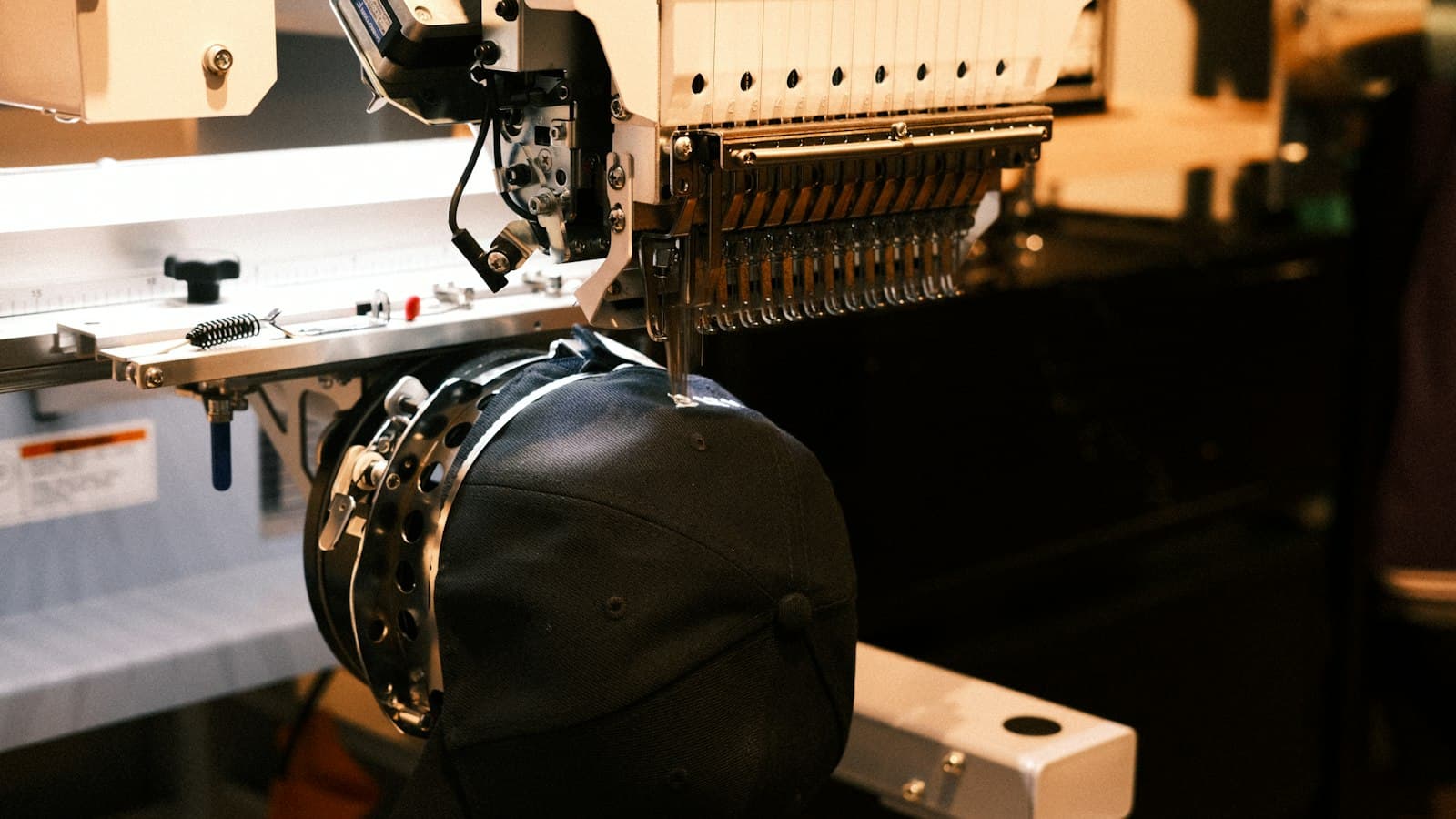
Cap embroidery is not flat embroidery on a curved surface. It runs on a cap frame, sews on a curve, and works outward from the centre — all of which make it slower and more error-prone at the same stitch count.
What adds time and risk
- Hooping each cap individually — no ganging several on one frame
- Buckram in a structured front resisting the needle
- Design height limited by the crown, so tall logos need redrawing
- Text near the seam distorting
- Higher thread break rate than flat work
- More operator attention per unit, so less machine autonomy
The practical consequence is that a stitch-count price built for left chests will underprice caps. Either run a separate headwear rate or apply a clear uplift, and be able to say why if asked.
Design height is a real constraint rather than a preference. A logo taller than the crown allows will either be shrunk until the detail closes up or run into the seam, and both outcomes are the shop's problem — so check the artwork suits a cap before the price goes out.
Other decoration
| Method | Reality on headwear |
|---|---|
| Embroidery | The default; best perceived value |
| Heat transfer / DTF | Works on flat unstructured fronts; needs a cap platen |
| Leather / woven patch | Patch cost plus application; strong margin |
| Screen print | Rarely practical on a curved front |
| 3D puff embroidery | Premium look; digitising must be built for it |
Patches deserve attention as a pricing option. A woven or leather patch bought in and applied carries a predictable unit cost, sews faster than a dense logo, and customers read it as a premium finish — so it often prices better than the embroidery it replaces.
3D puff needs its own digitising file. A flat file run as puff produces a mess, and quoting puff at flat digitising rates means absorbing a second setup — say so at the quote stage rather than at invoicing.
Quantity breaks
Headwear breaks flatten quickly, because the blank cost does not fall the way decoration cost does.
What actually changes with volume
- Digitising is one-off — it disappears fast across a run
- Machine time per cap barely improves; hooping stays one at a time
- Blank cost improves only at supplier case and volume thresholds
- Freight per unit improves on larger orders
So a headwear break structure should be shallower than a shirt one. Promising the same discount curve you use on tees is the specific mistake that turns a large cap order into a low-margin one, and the mechanics are the same as setting breaks anywhere else — the curve just has less to give.
Quoting it
Give headwear its own line with its own quantity. A customer ordering ninety-six shirts and twenty-four caps is placing two orders, and pricing the caps at the ninety-six-piece rate is a discount you did not intend to give.
On the quote
- Cap style and colour, named exactly
- Quantity for the headwear alone
- Decoration, position and stitch count or patch cost
- Digitising as a separate one-off line
- Any supplier minimum affecting the quantity
- Sizes carried, where the style is fitted
Where quoting is handled in software, headwear is exactly the case that justifies a separate price grid rather than a modifier on the shirt one. Quoting and order management built for decorators lets a product carry its own break structure, which stops the shirt curve leaking onto caps every time somebody is in a hurry.
Keep the digitised cap file with the customer's other artwork so the second order needs no setup at all. That is where headwear becomes genuinely profitable — the first order pays for the file, and every one after it is machine time on a job you have already solved. The rest of the pricing archive assumes caps are quoted as their own product.