The short answer
- Thread has physical width — detail below it cannot exist, however good the file
- Gradients, fine outlines and small text are the three that fail
- Lettering below roughly 5mm is unreliable on most fabrics
- An embroidery version of a logo is a legitimate, chargeable piece of work
- Show the customer a stitched sample rather than explaining it in words
A customer sends a logo that has printed beautifully for years and asks for it on polos. It comes back looking crude, and the shop is blamed for a limitation that was never in the file. This is one of the most common friction points in decoration and it is entirely predictable.
The cause is physical rather than technical, which is why no amount of skill in digitising fully solves it.
Thread is not ink
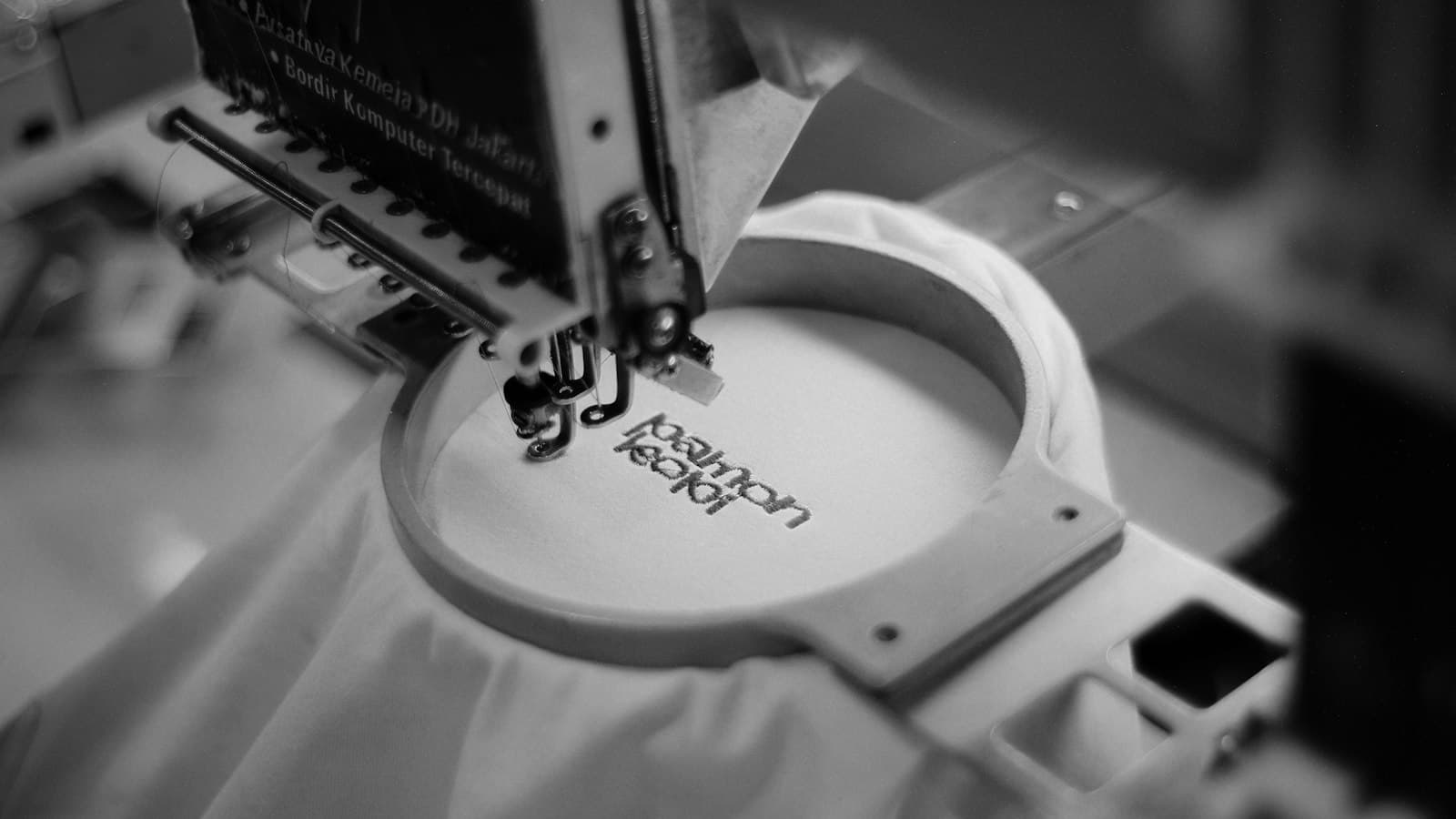
Ink can be laid down as thin as the mesh and the fabric allow. Thread has a fixed diameter, and a stitch has a minimum practical length. Detail smaller than those cannot be reproduced — not because the digitiser lacked skill, but because there is nothing to make it out of.
| Embroidery | ||
|---|---|---|
| Minimum detail | Very fine | Limited by thread width |
| Gradients | Natural | Not possible — blending only |
| Colour count | Cheap in digital | Each colour is a thread change |
| Colour matching | Mixable in spot | Nearest available thread |
| Fabric effect | Sits on or in the surface | Fabric moves under the stitch |
| Small text | Reproducible | Unreliable below ~5mm |
The last row is where most disputes start, and the fabric matters as much as the size — a fine woven shirt holds small lettering that a fleece will not.
What fails
Gradients and soft shading. Thread cannot fade. A gradient becomes either a hard colour break or a blended fill approximating it with alternating stitches, and neither looks like the original.
Fine outlines. A hairline keyline around a shape becomes a run of stitches wider than the line was, which thickens the outline and closes small gaps.
Small text. The commonest failure. Letters need enough width for the stitches forming them, and counters — the holes in an a or e — close up when the design is too small.
Very large solid areas. Not a detail problem but a practical one: a large filled area is a high stitch count, which is expensive to run and heavy on the garment. It affects what the job costs more than how it looks.
You cannot stitch something narrower than the thread. That is the whole constraint.
Minimum sizes
Establish your own limits rather than adopting a figure from elsewhere, because they depend on your machine, your thread and — most of all — the fabric.
Test once, record the results
- Stitch a test file with lettering at descending sizes
- Do it on each fabric you commonly run — woven, piqué, fleece, performance
- Note where letters start closing up and where they become unreliable
- Test the same for line weights
- Record the limits where whoever quotes can see them
As a starting expectation, lettering below about 5mm is where problems begin on most fabrics, and coarser or stretchier materials need more. Treat that as a prompt to test rather than a number to quote.
The point of recording it is quoting. A salesperson who knows the shop's real minimum can tell a customer at the quote that their strapline will not stitch at that size — which is a conversation about options, not a complaint after delivery.
Simplifying a logo
Most print logos need an embroidery version, and producing one is real design work rather than a conversion.
What usually changes
- Gradients become flat colours
- Fine outlines thicken or disappear
- Small taglines and registration marks are dropped
- Close-set elements are separated slightly
- Colour count is reduced to limit thread changes
- Small counters are opened up
Do this before digitising, not during. A digitiser given an unsimplified logo will make these decisions for you, and they will make them without knowing which parts of the brand matter — which is how a strapline the customer cares about gets dropped silently.
Charge for it. It is skilled work, it produces an asset the customer keeps, and framing it as a one-off that never repeats makes it an easy sale — exactly like the digitising charge it sits alongside.
Colour
Thread comes in a fixed range and cannot be mixed. A brand colour that falls between two threads gets one of them, and no process exists to split the difference.
Where a customer has a strict brand colour, show them the two nearest threads on the actual garment and let them choose. That converts a limitation into a decision they made — which is a completely different conversation from a match you promised and did not deliver.
Record which thread was chosen against the customer, with its number. A reorder stitched in a different thread reads as inconsistent quality, and it is the same discipline as recording an ink mix.
Where the garment changes the answer
The same design behaves differently on different fabrics, and a limit established on one is not a limit on another. A piqué polo, a fleece hoodie and a performance knit each move under the needle by a different amount.
Fleece is the hardest case. The pile stands proud of the stitching, so fine detail sinks into it and small lettering disappears — designs for fleece frequently need a larger minimum and sometimes a topping to hold the stitches above the surface.
Stretch fabrics move as they are stitched, so a design that registers cleanly on a woven shirt can distort on a performance top. That is a stabiliser and underlay decision, and it is the reason a file digitised for one garment should not simply be reused on another.
Explaining it to the customer
Show, do not tell. An explanation of thread width sounds like an excuse; a stitched sample is self-evident.
What works
- Keep a sample garment showing small text at several sizes
- Show the simplified version beside the original at actual size
- Name what you dropped and why, before they notice
- Offer a stitched sample before the run where it matters
- Put the stitched size on the proof, as a measurement
The sample garment is the single most useful thing to have on a counter. Thirty seconds of a customer looking at real stitching at real sizes settles a conversation that ten minutes of explanation will not, and it moves the discussion to what the design should become rather than whether the limitation is real. The rest of the artwork archive assumes the embroidery version is drawn before it is digitised.